Category: Functions

  • Follow Friday – Gene Kim

    Follow Friday – Gene Kim

    I love to read, but I much parables to a straight textbook-style book when it comes to business-type books or personal growth books. For example, some of my favorite business-type/personal growth books are:

    If/when I write my personal development book that has been rolling around in the back of my mind, I’m definitely going to make it a parable-style book.

    Many companies are trying to become more agile and adopt a DevOps (or DevSecOps) mindset. If you are a leader in any of these companies (or an individual contributor for that matter), you need to read books by Gene Kim.

    The Phoenix Project: Most people who are considering a move to Agile have heard of The Phoenix Project and I would definitely recommend reading it to get an understanding of Agile and Lean principles.

    The DevOps Handbook: In his second book, Gene Kim definitely goes more practical and gets into the nuts and bolts. This is not a parable-style book. This one gets into the details of how (and why) to implement DevOps. When I was at my previous company, I lent this book to both our IT Audit lead as well as our Change Management lead to help get ahead of some of the objections that I knew would come if we were to fully implement Agile/DevOps practices.

    The Unicorn Project: Gene Kim returns to storytelling in his latest book as he dives into the story of Parts Unlimited as a group of rogues implement the Three Ways of DevOps. A lot of people haven’t heard about The Unicorn Project which is a shame because it is a fantastic book and a great companion to the other books.

    I hope this post was helpful, especially to those looking to implement Agile/Dev(Sec)Ops practices within their organizations.

    Follow Gene Kim: Website | Blog | Twitter

    Follow Friday posts are posts where I highlight someone I follow as a way to promote and encourage others.

  • (Service)Now we’re Talking

    (Service)Now we’re Talking

    For those that know me personally, they know I have always been a software guy. I’m a developer by training and have always enjoyed software. Apart from a short stint at Arthur Andersen right after the dot-com bust (4 months before they got rid of my entire group several months before the Enron scandal) ConocoPhillips/Phillips 66 was the only company I worked for where what I did wasn’t directly related to what we sold as a company. Before working there, I had run my own software company Two Miles Solutions (I still keep it as a side gig). Before that, I had worked at Epic and WTS Paradigm (both are leading software companies in their respective industries).

    In a previous role at Phillips 66, I had been the platform owner for ServiceNow and had worked very closely with several folks, and had been very impressed with the quality of people I worked with. As I learned more about the company like their purpose statement (which I have seen them embody).

    We make the world of work, work better for people.

    I found with each piece I learned I aligned closer and closer to who they are as a company. For instance, their Code of Ethics could be boiled down into 3 simple words that resonate deeply with me. Integrity, Teamwork, and Trust.

    As I worked my way through the interview process, each person I interviewed with I was very impressed with and could envision myself working for very easily.

    The piece of information that sealed the deal was at the end of my last interview, the panel members asked me if I had any questions. I asked them

    “What is the question you wished you would have asked before joining ServiceNow? What is the answer to that question?”

    The panelist who answered didn’t skip a beat and addressed his major concern when he joined on whether or not ServiceNow was really a family as everyone said they were. He had come in from one of ServiceNow‘s partners so he felt like they had to treat him nicely because he was a partner. He spent the first 18 months of his 2 years at ServiceNow trying to disprove the premise they were all a family and he said he finally had to give up because he just couldn’t. They really were a family. That did it for me, I was sold.

    So there you have it. A lot of people guessed I had landed at ServiceNow as a Principal Success Architect in the Customer Outcomes organization. Well, pat yourself on the back, you were correct!

  • Hanging up the Shield

    Today is a bittersweet day for me. Today, I hang up the shield. After 10 years at Phillips 66 (Phillips 66 was spun off from ConocoPhillips in 2012, the split was announced a month after I started and I began working on the split at that point so I consider pretty much all of my time at ConocoPhillips as Phillips 66 work) I am moving on to a new opportunity starting on Monday, but before I go, I wanted to reflect on my time at Phillips 66. I have much to be thankful to Phillips 66 for. I started as an individual contributor and worked through several levels of leadership including functional leadership in some of our IT and company global events. I met some of the best people I’ve ever worked with in my entire 20-year career and was able to channel my passion for personal productivity into a group that is now one of the primary vehicles for end-user training at the company. I have been very blessed to have been at Phillips 66, my personal growth has been astronomical.

    As I move onto a new endeavor though, I want to speak to my friends, former employees, and mentees at Phillips 66. I meant it when I said I wanted to stay in touch. You are all phenomenal people and I am deeply grateful to have met you and I’m one of your biggest fans and hope you go on to crush all of your goals. Remember, I’m only a text/email/phone call away and I mean that.

    Keep Providing Energy and Improving Lives with Safety, Honor, & Commitment and I will be over here cheering you on!

  • Ask the Dumb Question…

    I recently made a post on LinkedIn that got a lot of attention and interactions so I wanted to take a moment to share it here and expound on it with a blog post.

    I’ve been in IT/Software Development troubleshooting problems for 20 years now and it never ceases to amaze me what question unlocks the answer to solving the problem at hand.

    I was on a troubleshooting call with my team and the other teams involved with troubleshooting an issue that has been plaguing one of our servers for months now. About halfway through the conversation I thought about asking a dumb question because I knew it really wouldn’t solve our problem.

    We were getting towards the end of the conversation and the only option we really had at that point was a Hail Mary type solution that no one was particularly fond of but was the only option we could see with the information we had.

    So I asked my dumb question…

    Which led to a question from one of the server experts on the call…

    Which led to an explanation that triggered a light bulb moment for the expert.

    Now we have a good path forward and our teams will hopefully be able to solve this longstanding issue today.

    As we hung up the phone last night I realized that in most of the troubleshooting situations I’ve found myself in over the years, it’s the seemingly dumb question that unlocks the resolution…

    LinkedIn post on asking the dumb question – 2/10/2021

    The post above got a lot of interaction (for me) and resonated with a lot of people. To expound on the post though, how do you ask the dumb question well?

    1. Don’t be known for the dumb question. This one should be pretty self-explanatory but if you’re known for asking the dumb questions, that’s not a good thing.
    2. Admit that it’s a dumb question. I’m not a big fan of the term “thinking outside the box” because I subscribe more to the concept of throwing away the box in the first place. Not everyone is there though so you may need to make sure people understand that you’re asking the question to spur on discussion, not because you feel the question has merit.
    3. As a leader, use the dumb question sparingly. In the scenario I described above, we had come to the point where we had pretty much exhausted all options. What was needed was something that would get people out of their current mental groove so they could look at the problem in a different light and see things they hadn’t seen before. In most cases, the grooves are there for a reason so knocking people out of the groove too often is just plain annoying.

    Two of the commenters on the post mentioned humility/vulnerability and while I wasn’t thinking in those terms when I asked the question, I think they’re on to something. If our teams see us willing to ask the dumb question and not always try to save face, how much better will they be because they’re willing to ask the dumb question because they’ve seen it modeled?

  • Resolutions Fade… Now What?

    Statistically speaking, more than likely, when (if?) you went to the gym this morning, the parking lot was probably a little emptier, you’ve had that tub of ice cream, or are already behind on some other resolution you set at the beginning of the year. As nice as it is that you can now get your favorite bench for International Chest Day (a.k.a. Monday) you’re probably pretty frustrated with yourself at this moment.

    Let yourself off the hook… and move forward…

    I’ve never been a fan of new year’s resolutions; what I am a big fan of is continuous improvement and building systems that move you towards your goals and who you want to be. When people ask me how to do that, one of the first tips I give them is to find that slack time in their schedule and find some small habit to implement.

    For me, from a personal improvement standpoint, my favorite slack time to take advantage of is that few minutes while my laptop is starting up in the morning. My coffee is always ready before I sit down so it truly is slack time. I always keep some business or personal improvement book on my desk and read a chapter as I’m waiting for my laptop to log in and my autostart applications (you are automatically starting the applications you use every day aren’t you?).

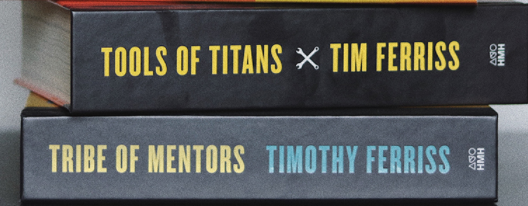
    As I mentioned above, they’re usually business or personal improvement books, however, I would recommend you start with either Tools of Titans or Tribe of Mentors by Tim Ferriss. Why do I recommend you start with one of these two books? Because they’re MASSIVE! Tools of Titans is 736 9″ x 7″ pages and Tribe of Mentors is 624 9″ x 7″ pages, these things are tomes. I want to teach you a lesson. A lot of people I talk to tell me they don’t have time to read when in reality they have plenty of time to read and by taking it in small bite-sized chunks anyone can get through these extremely large books, it may take you a year to get through one but, if you can get through one of these suckers those tiny little business parable books you have on your shelf will be nothing.

  • In light of yesterday’s events (a.k.a. yesterday sucked)

    As a leader, today you’re probably dealing with a lot of emotions personally as well as with your team members. As I worked to navigate this with my team, I sent the following note, feel free to borrow & modify as you see fit.

    Team,

    I wanted to send a note to the team in light of yesterday’s events, that being said, staring at a blank email I struggled to know where to even begin so I apologize this didn’t come out first thing this morning.

    Having lived in all the different places I have lived, my social media feeds encompass the entire political spectrum and it is VERY evident, regardless of where you land politically, yesterday was a day of major disappointments and frustration and I personally don’t remember a day where I was as easily distracted by every alert that came across my phone more than yesterday. A day fraught with as much emotion as yesterday had, many people are probably still feeling the effects and probably will for a while. The question becomes how do we move forward? That question will be addressed at multiple levels of our society many of which we have no control over, but in the span that we control as a team I’d like to set some guidelines.

    1. Start with the fact that on a continual basis, everyone on this team has exhibited that even though there are wide differences of opinion on many different subjects, we all care about each other and want what’s best for each other. With this fact as the foundation of how we interact with each other, we’ll get through this just fine and come out stronger on the other end.
    2. Acknowledge whether or not you’re ready to discuss what happened yesterday and be transparent with those on the team and respectful when others tell you they don’t want to talk about it or be around it being discussed. It is ok if emotions are still too raw.
    3. If you’re not ready to engage with the team, engage with someone in a constructive manner whether that be a friend, partner/spouse, or a professional counselor (for the employees in the group do not hesitate to engage our EAP resources, contractors, please work with your company to understand what benefits you have available). Do not go through this alone!
    4. Consider a media/social media fast – Tim Ferriss made a great point yesterday when he posted and followed up on this Tweet [added below], sometimes the worst thing you can do in moments like this is to keep scrolling…
    5. Finally, if at all possible, avoid echo chambers. When you’re ready, seek different perspective and understandings of what happened. We can all use this as an opportunity to grow. As terrible as yesterday was, it would be even more terrible if we didn’t learn from it and the only way we can do that constructively is together.

    As you all know, my door is always open, please feel free to engage me with any questions you may have.

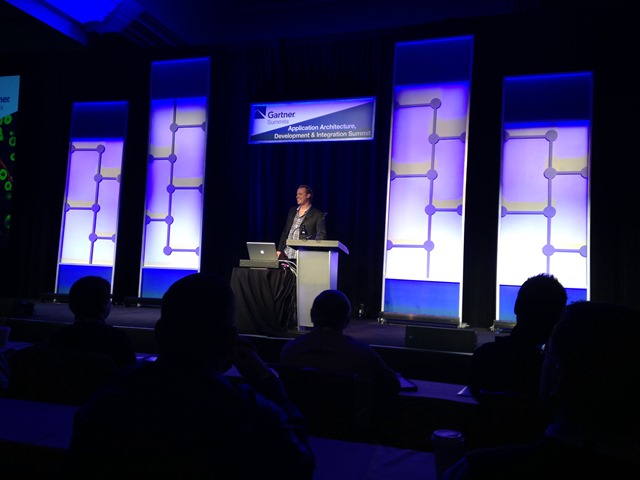
  • 2013 Gartner Application Architecture, Development & Integration Summit – Day 3

    2013-12-05 08.36.25

    Disruptive Fun

    The keynote speaker this morning was Ze Frank, the Executive VP for BuzzFeed. He talked about the 3 major disruptions in his life and how they got him to where he was. The cool part about this keynote is that he was able to take his learnings from the media world and apply them to IT and essentially say that the core fundamentals that every company deals with are the same. He shared some beautiful and hilarious stories from his journey and overall it was a great talk. If you ever have a chance to listen to Ze Frank I would definitely recommend it, he is a very insightful communicator that you will have a great time learning from.

    Ten Essential Principles of Modern Application Architecture

    This session was a great wrap up to all the things that I heard over the course of the summit. The basis was a service oriented architecture, then from there you can build the quick delivery context aware applications that we need to move towards amidst the Nexus of Forces.

    Summary

    Overall, I thought the summit was a great conference and I learned a lot of things I can take back and begin to push the implementation of at our company. I wish though that others from my company had been here, especially from our integration group.

  • 2013 Gartner Application Architecture, Development & Integration Summit – Day 2

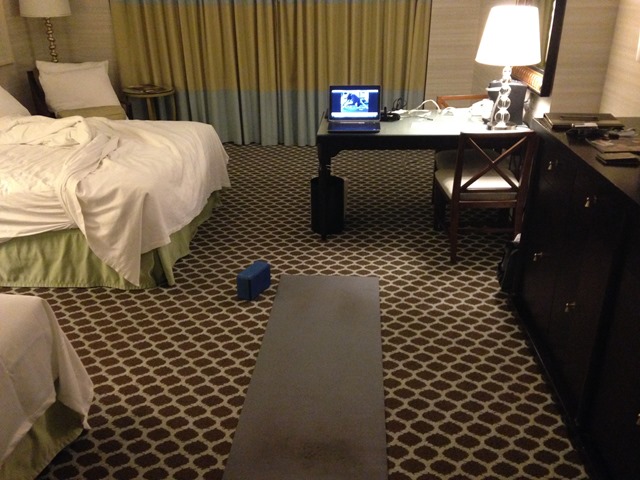
    2013-12-04 05.27.32I expected some nickel and diming when I came to Las Vegas but then I realized that nickels and dimes were too cheap…The picture to the left is what my gym was on Day 2 of the Gartner AADI Summit 2013.  I had been told that there was a fitness center available but packed some in room workout capabilities into my suitcase just in case. I was right, the hotel wanted to charge me $25 a pop to use their “Resort” every time I wanted to workout. Thankfully, I packed my yoga gear and DVDs so I was able to get my workout in nonetheless without paying the extra $25.

    You didn’t come here to read about my workout though, here’s the good stuff!

    UX Design and the Enterprise Architect

    Who doesn’t want a little User Experience (UX) with their coffee? This was a really good session centered mainly around the paradigm shift that is coming/in process. “UX is the looming relevance challenge for IT organizations.” How true this is and how irrelevant are so many of our IT organizations. The speaker talked about the paradigm shift that is needed. He mentioned that you can’t just stick lipstick on a pig when it comes to UX. UX has to be the first part of the process and that is the fundamental problem with IT, we are engineers/developers first so we want our processes to be engineer/developer focused. However, when it comes to UX, design has to come first and it is not just aesthetics. It is fundamentally how your users interact with your apps. One key takeaway that I took from this session was with the fracturing of the UX between iOS, Android, & Windows Modern UI it is impossible to use a cross platform UX that fits with every platform so he recommended developing a corporate UX standard that would be standard across your apps and hold true to that UX framework to simplify your development.

    Atlassian: How to do Kick-@$$ Software Development

    Aside from the proliferation of the term Kick-@$$ (which the speaker tastefully warned the audience about at the opening of his session) throughout the length of this talk (to the point that I finally copied the text to my clipboard and just hit ctrl+v every time I needed to use it in my notes it was happening so often) this was an extremely good session. The premise of the talk was that in the movie Kick-Ass (I haven’t seen it) the main character decides one day that he is going to dress up as a super hero and fight crime…the first time he does though he is brutally beaten up and stabbed and it is not until he forms a team around him that he really starts to Kick-@$$ so to speak. Complete with the full getup (minus the mask – to which the speaker relayed to us that it is not smart to wear a mask in a casino :-), the casino had guards waiting for him at the elevator before he even made it from his room) the speaker lamented the early days as a software developer where he felt he would go out and save the world with software but just ended up feeling beat up and stabbed.  He then talked about Agile and its adoption history and how we are moving into a post-Agile world and companies are struggling to figure out how to deliver software more and more quickly in this new environment. He then talked about the 4 main ways that Atlassian does Kick-@$$ software development:

    1. Build Kick-@$$ things
    2. One Kick-@$$ team
    3. Kick-@$$ Collaboration
    4. Kick-@$$ Automation

    Overall, this was a great talk with a lot of cool takeaways the biggest one for me being how intently focused they were on being a development shop more and not growing their non-development staff in leaps and bounds, but enabling their developers to do the testing, support, & design roles by bringing in a few experts that trained their developers how to fulfill those roles.

    The Element: How Finding Your Passion Changes Everything

    This session was hilarious, though terribly named. Sir Ken Robinson gave an extremely engaging talk about talents and creativity and how they affect our ability to create and re-create our lives and the paths we take. Two key quotes I have from this session are “Whatever you woke up worrying about this morning…get over it! How important can it possibly be in the grand scheme of things.” and “Talent is often buried deep, the challenge for leadership is to create conditions where talent will show itself.” If you are interested, I would recommend watching his TED talks, he is a very engaging speaker and his views on education and the reform it needs seem to be very good.

    HTML5 and the Journey to the Modern and Mobile Web

    This was a really good background session on what HTML5 was as well as what it isn’t along with the common misconceptions surrounding HTML5. I could tell that both presenters really knew what they were talking about. One key takeaway came during the recommendations section of their session when they said, “If your team has not yet done so, learn HTML5 and CSS3 and emerging modern Web tools.”

    Microsoft: Delivering Revolutionary Modern Business Applications with Cloud, Data, and Devices

    This one was a good presentation on what is available using Windows Azure for a public cloud provider especially in conjunction with on premise solutions. A key takeaway here is that Microsoft wants to be your cloud provider and they are doing everything they can to make themselves the vendors of choice including giving you options to host non-Microsoft products on their cloud and having easy integration from the cloud to on-premise solutions giving you a truly integrated hybrid solution.

    Architecting and Developing Secure Applications

    This was a pretty meaty session for 4:30 in the afternoon, but it was a great one! He started out by saying that writing secure applications is a major paradigm shift for so many developers because what they don’t know CAN hurt them. He laid out 3 key issues then expounded on them. The 3 Key Issues were:

    1. Why should enterprises place an emphasis on application-layer security?
    2. Which application security testing solutions can help enterprises develop secure applications and how will these evolve?
    3. How should organizations take a 360 degree comprehensive approach to application security?

    I have a ton of notes for all the different sections, but if I were to recommend a starting point for anyone, look at the slide deck (see session title link), then go download the 360 degree approach white paper.

    Summary

    Overall, it was a really good day with a lot of information. I am almost to the point that I am on brain overload, but I think I have enough left for day 3 🙂

  • 2013 Gartner Application Architecture, Development & Integration Summit – Day 1

    2013-12-03 10.49.05I am currently in Las Vegas, Nevada for the Gartner Application Architecture, Development & Integration Summit (AADI). One of my goals for this year with my boss is to get outside the Microsoft bubble that I have been living in for the last several years and expand my horizons. We both thought this conference would be a good fit for that goal. I intend on blogging about this conference similarly to the way I blogged about Microsoft TechEd back in June (Day 1, Day 2, Day 3, & Day 4). Before I get too far though, I would like to make a comment about Vegas itself. Vegas is one of those places that I never had any desire to go to. I will say though, from a macro view, the place is beautiful, the grand hotels & casinos that you see as you drive onto the strip are absolutely breathtaking. The picture at the top of this post was taken as I stepped out onto a balcony during an intermission between two sessions. I will probably post at some point about my thoughts when you get up close with Vegas but the short version is that people just seem sad and it breaks my heart.

    Anyway, I don’t want to dwell on my personal thoughts on Vegas because that is probably not why you are reading this post. So on to the Summit. On to the sessions that I attended.

    Developing a Mobile Development Strategy

    This session was a good first session to attend. The speaker went through and laid out all the steps, pitfalls and the things to think about as an enterprise is building their mobile application strategy. One of the key points he made that I thought was great was that you don’t want to just replicate your desktop/web apps on the mobile device. You want to as the question “What does mobile enable me to do that I couldn’t do before? How does it fundamentally change the business process?” While this seems fairly intuitive, you would be surprised at how often the business asks for a desktop replacement app on their mobile device and it is our job as IT to help them figure out and articulate what features they really need on the  mobile device. Another key point that he brought up that I wholeheartedly agree with is that you need to develop a User Experience (UX) practice within your organization and he brought this home with the question “How many times have you had to take a training class for a mobile app?” Your mobile app user experience (and all your applications for that matter) should be intuitive and easy to use. The final point he made that I want to emphasize before moving on is that testing is integral to a sound mobile application development strategy.

    Gartner Opening Keynote: Making the Nexus Real

    I have never been a big fan of marketing speak and buzzwords. I am much more a fan of speaking plainly and getting to the point. Prior to yesterday, I didn’t really know what the “Nexus of Forces” meant. I didn’t waste too much time figuring out what it was ahead of time because I knew a group like Gartner would make it painfully obvious what it was. I was ABSOLUTELY right, I think I heard the term “Nexus of Forces” at least 300 times yesterday. To be brief the forces involved are Cloud (another buzzword I hate), Social Computing (usually just said as Social), Information, & Mobile. What makes the Nexus is that these forces when combined enhance and build upon each other in such a way that they amplify each other exponentially. Overall, the keynote was really good, marketing jargon and buzzwords aside. I think I could have listed to Daryl Plummer all day long. He is a fantastically engaging speaker that really knows what he is talking about. The keynote went through several case studies of companies that had successfully harnessed the Nexus of Forces to propel their business forward.

    The Impact of Nexus Forces on Your Application Strategy

    The key emphasis in this session was that your current application strategy is going to have to change. We are no longer living in the environment where software will live unchanged for decades. You MUST change! This was my first introduction to the Pace-Layering Strategy for your applications. The short and simple is that you divide your systems into three layers Systems of Record, Systems of Differentiation, & Systems of Innovation. The Pace part of it comes down to the pace at which those things change or are thrown away. His last takeaway similar to some of the others that I heard was that we as IT need to switch from project to product (app) thinking.

    Successful Applications Demand Selfish Software: Only the Paranoid Survive

    This was probably my favorite session of the day…his main point was that as IT we need to shift our focus from delivering projects to delivering applications. If you deliver projects you are judged by on-time, on-budget, & met functional requirements (all of which shift in the name of the project) and end up delivering an application that the users can’t stand and all the features that they would actually want were pushed to “Phase 2” which we all know never happens. Instead, we should  deliver selfish apps (not applications) that meet the user’s requirements. The features of selfish software are:

    • Black Belt Defensive Coding
    • Self-Diagnostic
    • Self-Testing
    • Self-Monitoring
    • Self-Reporting
    • Self-Healing (eventually)

    The other piece of information that I really liked was that he redefined “Legacy” software as software that is hard to change. I liked this new distinction of legacy.

    Town Hall: Enterprise and Application Architecture Best Practices

    This was a great session for me as the Application Architect for Phillips 66. When I took the role I took it knowing that it was a very amorphous/undefined role and that between my supervisor and I we would be determining what my role included. After hearing this session, I was greatly encouraged by the fact that the path that Mike and I have laid out for me and my role seems to be the right path…I seem to be doing the right things. The particular interaction that I felt particularly encouraged was in regards to how Solution (Project/Technical) Architects and Application Architects should interact and overlap which we seem to be doing right at Phillips 66.

    Trinity Millennium Group: Getting to Cloud – From Legacy to Agility

    This session was probably my least favorite and I probably should have left early…I really didn’t get much out of this session. It was another rehash or what Legacy 2.0 was and how their company upgrades applications for their customers.

    Gartner Keynote: Business Outcome-Driven Enterprise Architecture: A Quantum Leap in Delivering Value

    Even though I don’t currently operate in the Enterprise Architect role within our company, I am part of our companies EA infrastructure so I wanted to hear what EA was supposed to be or rather what it should be. This session was a very good session to attend for this information and I recommend that anyone in the EA role within their organization review the slide deck and if available watch the video.

    Summary:

    Overall, this was a great first day. You can’t expect every session to be riveting and life changing, but I did learn a lot from the first day and am looking forward to Day 2. Other than the snafu with the conference organizers not ordering enough lunches for everyone this was a very good day.

    [I was one of the people who missed out on lunch but found out too late to do anything about it so I went 12 hours between meals…makes for a very crabby Architect, let me tell you and is probably part of the reason I fell asleep during the Trinity Millennium Session :-)]

  • I don’t have birthdays, I level up!

    birthday-level-upFor those of you who know me, you know that the month of October is pretty crazy for my family…we have 4 birthdays during the month of October, including mine… I have decided that I’m not going to see it as a birthday though. I loved video games growing up and my favorite one was Final Fantasy (I still have it on my Gameboy Advanced). Final Fantasy was a role playing game where your team of four Warriors of Light, each carrying an orb representing one of the four elements, travelled the world defeating the enemies that were keeping the orbs dark and thus saving the world. Like most role playing games, as your characters fought battles and beat enemies they gained experience points. When they had accumulated enough experience points, they would “level up” which would result in them becoming stronger, more intelligent, and for those with magical abilities, more magical abilities. I made a decision this year when I had my birthday, I would no longer see it as getting older. I see that every day in the new gray hairs in my beard and hair that greet me anew each morning and the hairline making that slow, painful march towards the back of my head. What I want to focus on is this, “How did I “level up” with regards to Faith, Family, Fitness, Fun, & Functions?” After thinking about it, here is what I have come up with. This year I leveled up in the following ways:

    • Faith: While I have always tried to have an active devotional life, this year, I figured out what works for me. Thanks to the Bible App, I have found plans that work for me to get a good dose of the word (almost) every morning. I have always tried the route of reading through the Bible in a year, but most of the time it just wouldn’t sink in the way I wanted it to, the chunks were too big. This year, I started with a Joyce Meyer devotional plan and a Billy Graham devotional plan that were offered within the Bible App and I love it. I get a daily dose of Word along with the opinion and insights from people I greatly respect. In addition to this, I have been listening to the Church on the Move podcast on a regular basis. A few years ago, my in-laws bought me a 160 GB iPod and I filled that sucker up…I have sermons and podcasts going back to 2009 from Church on the Move and I figured out a nifty little trick on my iPod to be able to listen to them in chronological order so what I do is just start the first sermon and the let them go while I am working, mowing, or doing other things…it is awesome!
    • Family: Our family continues to get better and better. Caleb is reading like a champ and his teacher says he is just doing amazingly. Carrie is blossoming more and more each day. Abbie is coming full force into her personality and it is amazing getting to know this little fireball that is our third child. Mandy and I are more united than we have ever been, we don’t even fight over finances anymore :-). That is huge! The interesting thing about our finances and the stress it used to cause and how we resolved it was that it was one small change that we made to how we budgeted that got us on the same page and revolutionized how we communicated about our finances. It wasn’t a huge revelation, it was tweaking the way one piece of our finances was represented on our budgeting spreadsheet that helped us see exactly where we were with our money and with that one little clarification, we got it and we were able to see things eye to eye.
    • Fitness: If you have been reading my blog or known me for any length of time, you know I struggle with my weight and have been trying to lose weight for a long time. This year I had a revelation in how to structure my workouts so that they were actually doable. Previously, I had been trying to do P90X either in my morning or in the evenings but with 3 kids and running a business on the side I was very sporadic in my workouts and wasn’t seeing the results that I wanted. I tried working out at work by running on the elliptical but the frustrating thing was it took me 45 minutes to an hour during work to get a 30 minute run in, then I remembered that our workout facility at Phillips 66 has a pool…light bulb…if I go down and swim for 20 to 30 minutes, it only takes me a minimal amount of time to get from work to the pool and from the pool back to work…bingo…and the pool is open enough in the morning that I an get there almost every day because I can almost always find 30 minutes to get down to the pool. By getting consistent with the pool workouts it took the pressure off me trying to get an hour workout at home so I was able to cut my lifting routine down to 30 minutes a night which makes it so much easier to do.
    • Fun: The big win for Mandy and I this year was that we took the kids to Disney World. While that was the highlight, we have also tried to make sure that we do something fun on a regular basis. We just recently had a staycation where we went to Incredible Pizza, the Tulsa Children’s Museum, and had a movie night. We have fun. We also like to win and right now Caleb’s soccer team (the one I coach) is one win away from being undefeated this season. Carrie started dance lessons this past summer and absolutely loved them.
    • Functions: I hit a major career milestone this year. The interesting thing about it was that it came with very little fanfare through an IM from one of my co-workers and I didn’t even realize it was that much of a goal for me until I hit it. In my side business I also have a major announcement coming very soon which will be very cool for us and become a great avenue of blessing for us in addition to my main job at Phillips 66. I need to keep quiet on these things right now but will let you know as soon as I can.

    Overall, this has been a great year, I’m looking forward to how I will level up next year and what God has in store for me and my family. Sound off in the comments below with how this year has been a great year for you!